
| Search PNC News for stories of people and churches in our UCC Conference: |
|---|
Acting conference minister will make space to listen
As the Rev. Dr. Lorraine Ceniceros joined the Pacific Northwest Conference as the acting conference minister beginning June 1, she began meeting with the board and with groups to get acquainted.
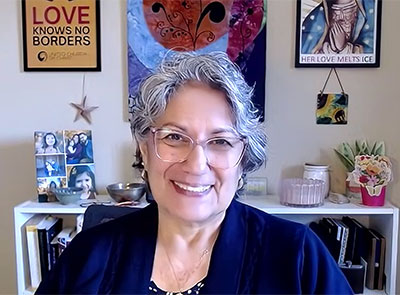 |
Lorraine Ceniceros will have hybrid ministry—in person and online—with PNC. |
Hearing of grief and conflict, she believes her skills as a pediatric hospice chaplain of having difficult conversations with families can help move the PNC from stuck to being curious.
“As a chaplain, I could walk into conflicted situations, hold space and hear the pain that was not being articulated,” Lorraine said.
“I hope to foster conversations to help people share their beliefs and concerns openly,” she said, “to help people be clear about what they want in a settled conference minister and in their life together as the conference.”
Lorraine, who is the third generation of a family who immigrated from Mexico to California, said that she hopes to help people clarify their goals and prepare the PNC for to live into them.
Lorraine served from 2022 to 2026 as the conference minister of the Kansas-Oklahoma Conference UCC and from 2019 to 2022 as associate conference minister for the Southwest Association of the Wisconsin Conference.
While pastor at a church in California, she also was chair of the Board of Directors for the Southern California Nevada Conference and on committees in the wider church.
Lorraine’s path to ministry began later in life. As a child, she and her sister attended a predominantly White, affluent, pentecostal Foursquare church It tolerated the diversity of having Hispanic kids until her sister was of dating age Then that toleration stopped. They didn’t want their sons to date her.
“While my family and I left that church, God never left me,” she said. “God has pursued me in unexpected ways and places.
“I grew up assimilating into the White culture because my parents believed that would be key to me succeeding,” said Lorraine.
After 20 years working with General Telephone of California, she took a buyout and moved to Sedona, Ariz., with her two children when she was seven months pregnant. She worked her way up to be a hotel desk manager and manage a stem cell storage facility.
When her daughter was 16, the daughter applied to do childcare at a predominantly White, affluent UCC church.
Lorraine went a few times.
“I perused a UCC website and decided that was the place I needed to be. I said, ‘Ok, here I am,’” recounted Lorraine, who accepted when she was invited to teach Sunday school.
“God was calling me back to church,” said Lorraine.
She completed a bachelor’s degree in political science and government with a focus on race, class and gender in 2008 at Northern Arizona University in Flagstaff.
Then she returned to California to study at Claremont School of Theology, where she earned a master of divinity degree in 2012.
Lorraine served a local church as a pastor and then worked in pediatric hospice ministry with a Catholic hospital in Santa Monica.
She began to recognize when she was a hospice chaplain that her ministerial skills would be useful in mid-judicatory ministry in the UCC.
She accepted a call to the Wisconsin Conference.
Meanwhile, she began work on a doctor of ministry degree at Louisville Presbyterian Theological Seminary. For that program, she wrote her thesis in 2025 on “Assimilation to Liberation: Ethnographic Narrative of Third Generation Mexican American Female Serving in Predominantly White Denomination.”
“Seminary was a safe place to deconstruct my theology and reconstruct a theology authentic to who I am and where I am in life,” she said.
“I hope to make a such a safe space here for people to deconstruct beliefs about race, so we do not call others racist. The system of racism is the water we all swim in,” Lorraine said.
She continued by explaining that growing up focusing on assimilating to succeed, she internalized racism, even against “people who look like me.”
“If I could be racist against my people, I needed to understand how we all keep systems in place that benefit White people,” she said, telling of unpacking that assimilation so she could more authentically be who she is.
“I it’s what it is like to be Hispanic and think White, and I know what like be proudly Hispanic. It’s hard to unpack systems that inform us before we are born,” said Lorraine.
“I am able to bring a big picture systems approach to help us visualize what is needed to put the pieces in place,” she continued.
“Systems and relationships are a central dynamic of change in church culture,” she explained. “I feel called to support the church and her pastors as we grow into a new way of being.”
Versed in the Manual on Ministry and UCC history and polity, Lorraine cares deeply about supporting UCC congregations and pastors in their work, especially when churches face conflict.
“Over time, in my early ministry, I developed a preaching style that sought a middle road, trusting that if I stayed there, everyone might find themselves somewhere in the Word,” she said.
Recently, however, she has been stirred by the prophetic call—during a vigil for Renee Macklin Good—from Episcopal Bishop Rob Hirschfeld of New Hampshire, advising clergy to prepare their wills, because the “cruelty, injustice, and horror that has been unleashed in Minneapolis” calls faith leaders to “stand with our bodies between the powers of this world and the most vulnerable.”
She noted that “the most vulnerable” now include those exercising their First Amendment right to protest and to make their views known.
Straddling the world of her ethnicity and the world of not wanting to alienate congregations, images of young people being arrested, targeted for being brown expanded her discomfort.
Her support of eight Kansas Oklahoma clergy who went to Minneapolis was not about Republican or Democrat, right or left, conservative or progressive.
“It’s about our shared humanity,” she said. “It’s about the Gospel call to love our neighbors, and to love others, every single other. It’s about treating the vulnerable among us with dignity and care. It’s about standing between powers and principalities and those who are being dehumanized.”
Just after Lorraine decided it was time to leave the Kansas Oklahoma Conference, she contacted Diane Wieble, the UCC national staff person who places conference ministers, and learned the PNC was open.
“I follow where the Spirit leads, and it was to the PNC,” she said.
Since starting her hybrid ministry with the PNC, Lorraine has learned about the spoken and unspoken grief in the PNC about Phil Hodson not being called as settled minister, about not having a settled minister for a long time, about some wanting a woman of color lead the conference.
She calls for honest conversations about where people are and calls for people to give each other the space to listen to each other.
“To move forward, we need people to be curious about what that means for different people,” Lorraine said, believing it’s “possible to create a space of love so we can hear, learn from and unpack each other, recognizing we are all racist, and racism supports systems that separate us.
“We never know where Spirit will lead us,” she affirmed.
For information, email lceniceros@pncucc.org.
Pacific Northwest United Church of Christ Conference News © June 2026
Share this article on your favorite social media 